

When Legends Collide: The Night Larry Bird and Julius Erving Lost Control
- Vlatko Atanasoski

- Apr 24
- 3 min read
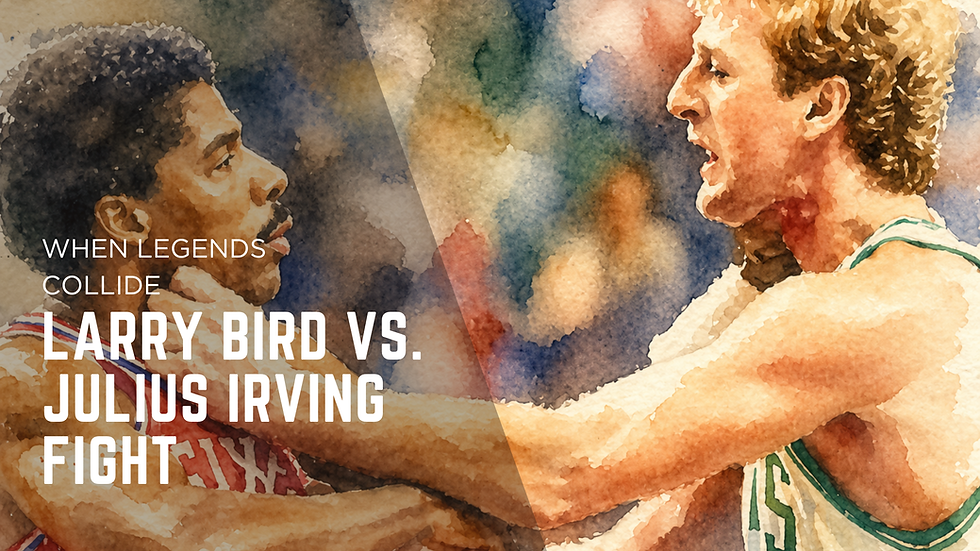
There are moments in basketball that live far beyond the box score—moments that feel less like sport and more like rupture. On a cold November night in 1984, inside a game between the Boston Celtics and the Philadelphia 76ers, something broke.
Not the game. Not the rivalry.
But the illusion.
The illusion that greatness is always composed, controlled, untouchable.
The Temperature of the Era
To understand what happened, you have to understand the atmosphere. The NBA of the 1980s wasn’t just competitive—it was territorial. Every possession carried weight. Every matchup had memory.
Larry Bird played like a man who wanted to prove something every night—not just that he could win, but that he could dominate psychologically. His game was precise, efficient, almost surgical. But beneath it ran something sharper: an edge that lived in words, glances, and timing.
Across from him stood Julius Erving—Dr. J—the embodiment of grace. He moved differently, carried himself differently. If Bird was confrontation, Erving was elevation. If Bird imposed, Erving transcended.
They weren’t just opponents. They were contrasts.
The Breaking Point
The game had already tilted in Bird’s favor. He was scoring, controlling tempo, pushing boundaries—not just physically, but mentally. For Erving, it wasn’t just about being beaten. It was about how it was happening. There are moments in sport when tension accumulates quietly, invisibly—like pressure in a sealed room. Then something small happens. A foul. A word. A look held just a fraction too long.
And suddenly, everything changes. Bird delivered another hard play. Contact lingered. Words followed. And then—almost instantly—Erving reacted. Hands reached. Jerseys tightened. And in a flash that felt both sudden and inevitable, the two were locked together, throwing punches.
No choreography. No hesitation. Just emotion.
Shock, Not Chaos
What made the moment unforgettable wasn’t the violence—it was the disbelief.
Because this wasn’t supposed to be Julius Erving.
Erving, who rarely lost control.Erving, who carried the game with dignity.Erving, who didn’t descend into moments like this. And yet, here he was. Years later, he would reflect on it not with pride, but with distance. He didn’t celebrate the moment. He didn’t revisit it often. If anything, he resisted it—refusing to let it define him. He would suggest that Bird had been pushing, that something had built over time. But even then, his tone remained measured. As if the fight itself was less important than what it revealed: that even the most composed figures have limits.
The Silence of Bird
If Erving reflected, Bird largely dismissed.
That, too, fits. Bird was never interested in narrative. He didn’t mythologize moments—he moved past them. Where others saw drama, he saw competition. Where others saw conflict, he saw consequence.
In his version of the world, things happened because they were part of the game.
Nothing more. And yet, those who watched closely—teammates, opponents, insiders—understood the subtext. Bird’s presence wasn’t passive. His words mattered. His timing mattered. He knew how to apply pressure in ways that didn’t always show up on film. The fight may have lasted seconds. But the tension behind it had been building far longer.
What It Meant—and What It Didn’t
The strangest part of the story is what came after.
No feud.No lingering hostility.No mythology between the two men themselves.
Over time, Bird and Erving moved on. They shared space again—commercials, events, the quiet fraternity of legends. Whatever happened that night stayed there. That’s what makes the moment so compelling.
Because history remembers it as a clash—but the players remember it as a moment. A brief loss of control in a game built on control.
The Myth and the Truth
Today, the footage circulates endlessly. It’s labeled, replayed, categorized:
“One of the greatest fights in NBA history.”
And maybe it is. But that framing misses something. The fight isn’t important because punches were thrown. It’s important because it revealed something rare: That even in an era defined by toughness, even among players defined by greatness, there were moments where emotion broke through the surface.
Where competition stopped being strategic and became personal. Not permanently. Not destructively.
But unmistakably.
What Remains
In the end, the Bird–Erving fight doesn’t diminish either man. It deepens them.
It reminds us that greatness isn’t the absence of emotion—it’s the ability to carry it, control it, and sometimes, lose it. Just for a moment. And then move forward. Because that’s what they did.
And that, more than anything, is why the moment still matters.
Comments